A case study of space settlement, through a business-oriented lens
At first glance, it might seem odd that a blog dedicated to finance, economics, and business is taking on a question of what seems to be purely scientific proportions. However, the answer to this question has significant implications for the international , or perhaps in the future, the inter-planetary economy. With the establishment of space settlements comes the chance to harness the resources of multiple new planets and natural satellites, allowing for markets to develop due to populations on other worlds exporting goods and services to one another. This has the potential to radically reshape the global economy. If economically viable, space exploration could lead to almost unlimited potential for further growth, innovation, and increases in standards of living.
Limitations: Human development is notoriously difficult to predict, even in sweeping strokes. As I’m no visionary, I’m limiting myself to (very tentatively) considering the narrow field of space settlements specifically, rather than the space sector as a whole, over the next 50 years at the very most. Additionally, I’m not going to focus on specific technological developments that we’re likely to see – I’m generally going to assume that space-related technology will develop at a steady trajectory, lowering costs gradually and reducing barriers to space travel.
Key definitions
To make any guess about humanity’s ability to create space settlements with economic benefits in the foreseeable future, we first need to lay down a few base definitions for this article. So, let’s define:
- Space settlement: A permanent man-made presence in space that can sustain human life. In this context, I’m taking ‘sustain’ to mean providing human life with all essential goods that are required for survival – this means that any ‘space settlement’ would need to be able to provide its own food, water, energy, and life support systems that would be able to (theoretically) support basic functions of humans independently for the foreseeable future, allowing humans to stay on the settlement almost indefinitely.
- Economic viability: The point at which a project’s benefits exceed the project costs. In this case, as we’re approaching this from a financial perspective, the economic viability of a space settlement would be a point at which the value of goods and services it exports or outputs exceeds its’ required imports. However, exact definitions of economic viability may vary. For example, a nation might agree to establish a space settlement even when it isn’t expected to generate significant profits, as the ‘benefits’ from the perspective of national prestige outweigh the monetary costs. Similarly, research agencies may wish to establish space stations that are not monetarily profitable, to gain scientific insights and spur further development.
- Costs: The financial costs of the space projects. These costs can be broadly divided into two categories:
- Construction/Establishment costs: These are the costs that are required for a space settlement to be established. That would include the costs of all design work, transporting construction materials to the sites of the establishment, and assembly of the settlements’ initial structures
- Maintenance/Subsistence costs: These are the costs incurred by the continued maintenance of space settlements. This includes things like spare parts that must be imported from Earth, specialist equipment, etc.
Assumptions
To make reasonable predictions about the economic future of space settlements, we must also make assumptions about the development of space travel and the motives behind it. Those assumptions are as follows:
- The reach of humans will be limited to our solar system. Even utilising theoretical concepts currently proposed such as ‘solar sails’, spacecraft will be unable to travel at sufficient speeds to reach other stars, let alone establish permanent settlements there at any point in the foreseeable future.
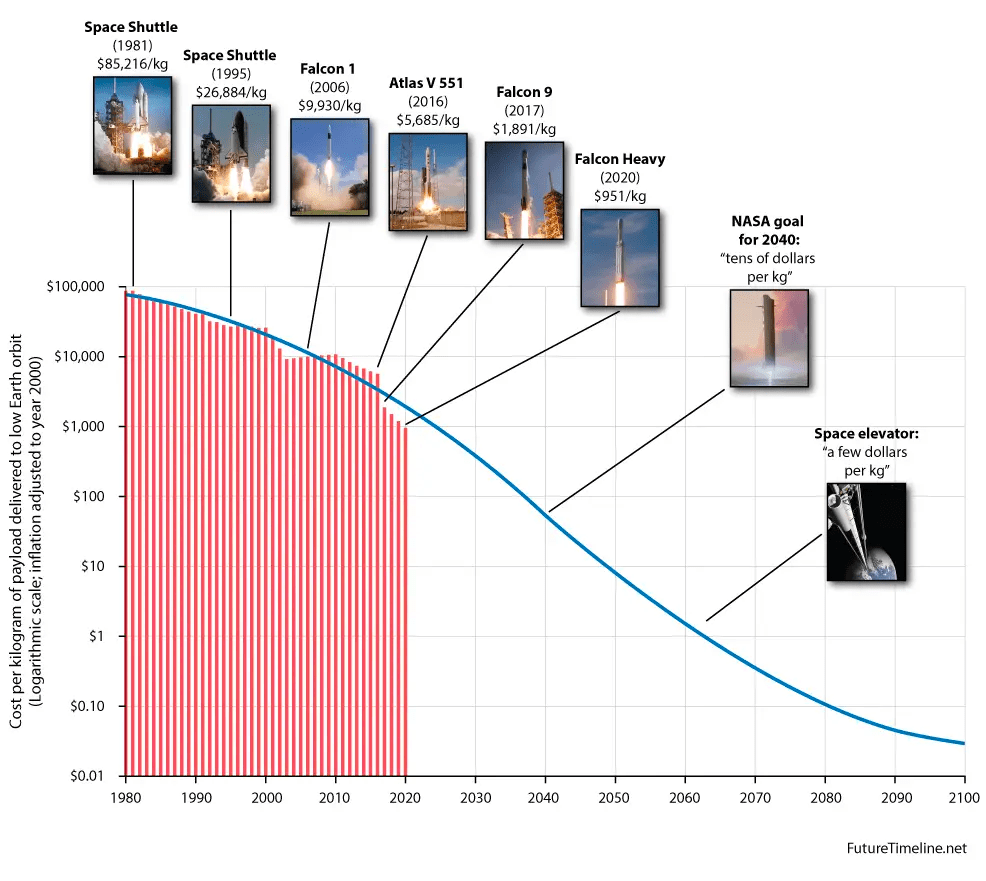
- The cost of space travel will trend downwards over at least the next 20 years. I believe that, with incremental advances and refinements, the inflation-adjusted cost of entering outer space will fall. Progress continues to be made on the reusability and modularity of rockets, saving costs on manufacturing. Furthermore, as rocket launches become ever more routine, the infrastructure to support rocket launches from Earth will continue to mature. Both of these factors will contribute to lowering the costs of delivering payloads, both to orbit or Earth and to other locations throughout our solar system. However, launch/placement costs will continue to make up a significant proportion of the total costs throughout the period we are looking at.
- The private space industry will only establish space settlements to either generate profits or as a pathway towards generating profits in the future. Although companies can and do regularly involve themselves in philanthropic work, the sheer magnitude of costs involved in the establishment and maintenance of space settlements mean that, unless monetised, companies will not seriously consider them to be worthwhile investments.
Orbital Settlements around Earth
Perhaps the cheapest and least technically challenging area to establish space settlements (that would be relatively easy to travel to and from in short periods) would be in orbit around Earth. This is the area into which the most practical research has been conducted – the International Space Station, Tiangong space station, and several others have given a wealth of practical and technological expertise that would reduce the costs of development and deployment of space settlements in this area. Therefore, let’s assume Earth Orbit settlements will be the first step that we’ll take towards space colonisation.
Now we ask: How could these settlements deliver a return on investment? Settlements in Earth orbit cannot collect any raw resources, and any manufacturing processes would be far cheaper to operate on Earth – despite decreases in space travel prices, hauling vast amounts of materials into orbit could not reasonably compete with terrestrial production techniques. Therefore, we’re left with one sector: services and hospitality. The novelty of space travel has already led it to become a fast-growing tourism sector – private citizens have paid tens of millions of dollars apiece for stints aboard the ISS, and Virgin Galactic has begun offering sub-orbital spaceflight opportunities. The allure of Space may mean that this market has even more potential to expand – orbital hospitality complexes, containing hotels, restaurants, and other entertainment may become profitable, catering (at least initially) to a wealthy class of holiday-goers seeking to expand their horizons, both literally and metaphorically.
But would those be space settlements? If we look at our definitions earlier, it is likely that ‘orbital hotels’ would be able to provide guests with space-grown food, and recycled water. Though much more specialised than terrestrial settlements, these establishments would need to employ staff such as maintenance workers, who would likely spend extended periods in orbit. Therefore, we can stretch the definition of ‘space settlement’ to encompass these potential stations in Earth orbit, which would act as an addition to the luxury hospitality sector. Although limited in scope, it could be possible to build a financially viable ‘space settlement’.
The Moon
The next logical step from near-earth orbit settlements is the moon, Earth’s largest natural satellite. Although more expensive to reach and more remote, the moon is a much more promising site for profitable future space settlements than low earth orbit is. This is owing to one factor – the presence of water on the moon. As of 2020, the presence of water on the moon was confirmed by NASA, opening up many possibilities. Water on the moon can be processed into both oxygen, for life-support systems, and rocket fuel, allowing spacecraft to refuel themselves on the moon without going through the relatively expensive process of flying fuels up from Earth.
Perhaps even more enticing is the chance for extraction of natural resources which are in limited supply on Earth. The moon is suspected to have deposits of rare earth metals, gold, platinum-group metals, and isotopes of helium which can be used in nuclear fusion. As the limited supplies of earth-bound resources diminish, whilst demand continues to increase, there will come a point when space-based extraction is more cost-effective than continuing to search for and harvest what remains on our planet.

At first, this sounds very appealing. We’ve finally found a chance to create a profitable, permanent moon-based space settlement, creating a valuable product with advantages over earth-based alternatives. But on further examination, the creation of a ‘space settlement’ might not be as enticing as thought, for the following reasons:
- The price of lunar fuel: Although the moon has water, that can be converted into oxygen and rocket fuel, these are complex (and by extension, expensive) processes. As the cost of space flight, specifically lunar flight falls, it’s likely the cost of flying earth-extracted fuel to the moon will be cheaper and simpler than manufacturing moon-based propellants.
- Automation: Mining enterprises on Earth already use extensive amounts of machinery and equipment, meaning mining on Earth relies on humans only for minimal supervision, maintenance, and decision-making. With the continual advance of machine-learning technology, and the astronomically high costs (pun not intended) of sustaining a space-based workforce, it is likely that any companies venturing into lunar mining would do all in their power to minimise human presence. Therefore, by the time extra-terrestrial resource extraction becomes fully feasible, humans may not be required. Automation combined with remote control of those functions that cannot be completely managed by artificial intelligence would allow all of the benefits of tapping into the moon’s natural resources, without the costs associated with manned space exploration.
To be clear: This is not stating that permanent manned space bases on the moon will never be created. The allure of space-based life will be attractive to many, including those with the means to privately fund their accommodation. These ‘space pioneers’ will inevitably import goods and materials from Earth. However, these space bases, or the presence of humans on the moon, do not meet the criteria of a ‘space settlement’ as defined earlier. A handful of individuals living in, or spending time on vast lunar estates will be unable to provide economic benefits for Earth.
Beyond Earth Orbit: Settlements on and around other bodies in the Solar System.
As we go further from Earth, we see two things happening to our prospects for space settlement. One, the launch and establishment costs become significantly higher – the increased energy needed to escape Earth orbit, along with the development of new launch platforms capable of sending life to new worlds would mean that settlements on other planets would take much longer, and need to generate a much greater return on investment to be economically justifiable. Fortunately, there are confirmed deposits of iron and gypsum on Mars, the one planet that has a solid surface and is reasonably close to Earth. Additionally, it has multiple asteroids, both in the vicinity of Earth and in the asteroid belt between Mars and Jupiter, which may hold deposits of rare-earth metals and platinum with a current market value of trillions of dollars apiece. Given the scale of space-based deposits, rising domestic demand for diminishing supplies of terrestrial resources, and falling costs of space travel, asteroid mining is a viable business model that can be pursued over the next 50 years.
Ironically however, the potential of the asteroid mining industry would discourage, rather than accelerate space settlements. As discussed earlier, mining enterprises, particularly those which take place on seismically inactive, atmosphere-free sites like asteroids, are increasingly automated even on earth.
Therefore, fully automated asteroid mining will outcompete Mars-based resource extraction for the foreseeable future – There may be some need for long-term human presence on mars itself, owing to the potential for adverse weather conditions, tectonic activity, and other unexpected changes in conditions which earth-based controllers would be unable to respond to in time, and on-site AI may not yet be capable of responding to (At its’ maximum distance from earth, communications take 21 minutes to reach mars, and vice-versa, meaning that any instructions given to remote mars probes in the event of, say, a sudden dust storm, would arrive 21 minutes too late to save critical machinery). Asteroid extraction however is significantly cheaper, and has the potential to fulfil all of earths’ needs for rare earth metals over the next few decades.
Beyond mars, the economic rationale for human space settlements only decreases. The further out they are, the more prohibitively expensive the settlement costs will become, and the less likely it will be that space settlements established there can provide any economic benefit to humanity, at least by 2073.
The Future
This is not a declaration that space settlements beyond Earth orbit are impossible, or that humanity will never expand beyond earth. Massive expenditures of capital for seemingly no immediate return on investment are often needed to pave the way for monetisation of technical innovations – were it not for the tens of billions of dollars spent during the space race, we would almost certainly not have the extensive networks of communications and navigation satellites that have become vital to everyday life in the Western world. Similarly, only by spending large amounts of time and money on exploring our unknown and by optimising our progress through countless iterations of trial and error will we hope to succeed.
And at the same time, humans may yet set foot on, and even spend months living in and around other planets. From potential ‘moon villas’ to manned research stations, from the next generation of astronauts who will return to the moon and may even push humanity onto mars, our relationship with the great beyond is only just beginning. Even if by 2070 we do not have the space-based metropolises of science fiction, our Earth-based species, aided by our largely robotic extra-terrestrial enterprises will almost certainly have innovated and expanded, growing on this planet and transforming the world around us – that is, assuming we’re still around…
Thank you so much for reading through! I hope you found this article informative. I appreciate any and all feedback, constructive criticism, and advice, so if you have ideas for future posts, or you think I could have done something better when writing this article, don’t hesitate to leave a comment! -Alex
 On the money
Leave a comment